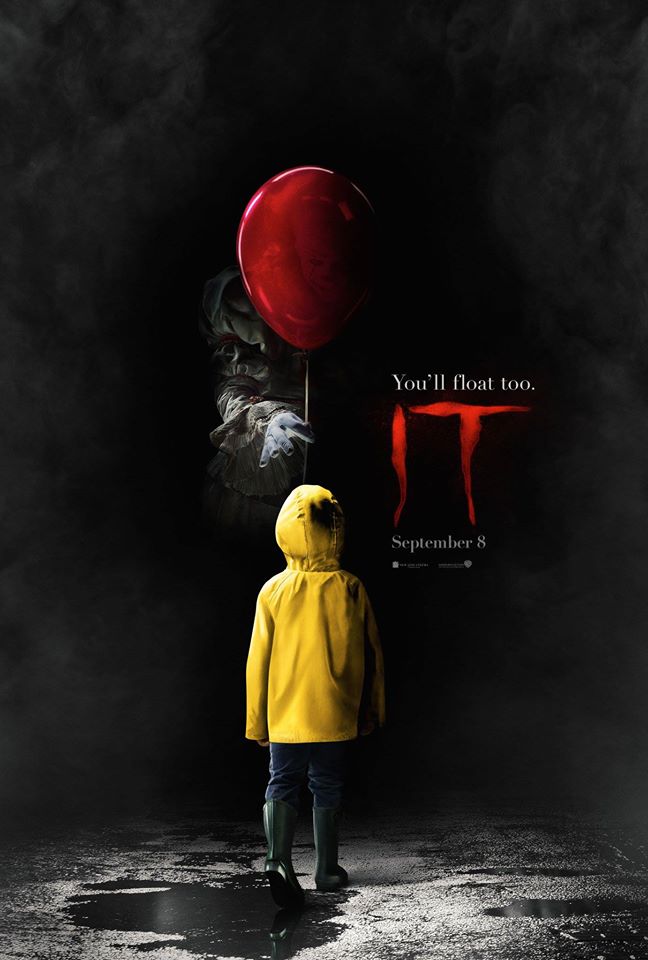
It is easily Stephen King’s most popular work out of his massive bibliography, a beloved novel from 1986 that comes in at nearly 1200 pages whose miniseries adaptation put the fear of clowns into an entire generation of children. Most fans who aren’t blinded by nostalgia realize that the 1990 adaptation was far from good and could have been much better if it wasn’t bound by the restrictions of television in the 20th century. Finally, after eight years in development hell, the cinema adaptation of the novel has hit the streets in full force. Originally supposed to be written and directed by True Detective’s Cary Fukunaga, the project was passed off to Mama director Andy Muschietti. Since release, the movie has being praised by both fans of horror and fans of King’s work all over the world. Warner Bros., wary of how fans of Tommy Lee Wallace’s miniseries would take to the new adaptation, put some serious limitations on the budget of the 2017 adaptation, one of the many reasons Fukunaga originally split. After many, many years keeping a close eye on this project and trying to keep expectations reasonable, we finally have the movie.
It begins with Bill Denbrough building his kid brother Georgie a paper boat to sail down the street in the rain, which as readers and those familiar with the miniseries know, leads to Georgie’s demise. Right off the bat, we notice the soundtrack and the inclusion of Bill’s stutter, which wasn’t present in any promotional media before release, and once Georgie loses his boat, we have our first encounter with Bill Skarsgard as Pennywise. Let me say that I was skeptical when I first saw the design. It looked cool, but it takes more than appearance to do justice to such a diverse and insane character. Fortunately, all it took was this scene alone to sell me on Skarsgard, from the subtle shift in eye color as he moves in and out of darkness to the copious amounts of drool you can see running from his mouth as he stares at Georgie from the grate. It’s a good thing that Skarsgard didn’t attempt to follow in the footsteps of Curry’s version and gave us his own twisted, frightening take on the monster, although I was mildly underwhelmed by the actual moment of Georgie’s death. I couldn’t put my finger on whether it was the CGI or the cinematography (although given that Chung-Hoon Chung is behind the camera, that’s not likely), but I felt as if the scene simply wasn’t graphic enough to drive home the horror. However, the way Pennywise’s eyes swivel in two separate directions is damn freaky, showing us that we’re dealing with something truly inhuman.
Soon after, we’re introduced to all of our main cast in almost a series of vignettes, first on their way out of school on the last day of classes before summer, and then into their individual encounters with “It.” I felt as if these 30-40 minutes are rushed, but I’m willing to cut it slack as it’s trying to fit about half of a 1200-page novel into two hours and fifteen minutes. We don’t get a lot of character backstory during these segments, but the movie picks back up after assembling the Losers’ Club with a push from the somewhat toned-down versions of the novel’s bullies. While all of them are terrible people, and Henry Bowers is graphically shown carving an “H” on Ben’s stomach, the movie does ask us to feel a little sympathy for Patrick Hockstetter before he’s killed in the ensuing chase scene. Once the kids are brought together by Ben, fleeing from a vicious attack by the Bowers gang, you start to see the cast’s chemistry unfold.
If there’s one consistent draw throughout the movie, it’s Finn Wolfhard’s portrayal of Richie “Trashmouth” Tozier, or “the man of a million voices,” whose filthy mouth and “voices” are showcased wonderfully in the film and much better than they were in the miniseries. I don’t think ten minutes pass where Richie isn’t dishing out spot-on teenager-style jokes, a far cry from the character Wolfhard plays on Netflix’s Stranger Things that he nails. Sophia Lillis’s take on Beverly Marsh is also much more accurate to her character in the book compared to the damsel-in-distress that Tommy Lee Wallace forced into the miniseries. This Beverly, a thirteen-year-old rebel who smokes cigarettes in the school bathroom, is so close to the source material it will make smile from ear to ear, and the Loser boys’ attraction to her is apparent, too, without crossing over into “creepy.” There’s a great scene in the movie where, after a swim in the quarry, the guys are dumbstruck by Bev as she dries off in the sun, dressed in nothing but her bra and underwear. All in all, from this point on, there isn’t a stale moment in the Losers’ Club, either in the kids’ performances or their character interactions.
I’m not quite sure where to start with Bill Skarsgard’s take on Pennywise the Dancing Clown. He’s amazing from a physical standpoint, moving sometimes diabolically slow to insanely fast to give him the inhuman aura of Stephen King’s monster, and his range of facial expressions underneath all that makeup and prosthetic work is just incredible. The moment that really made me go “Damn, this is fucking awesome” is in the confrontation in the house on Neibolt Street, which fans of the novel know well as one of the most terrifying scenes never filmed for the miniseries: Bill and Richie run in, Pennywise turns around to look Bill dead in the eye, and says, in response to Bill’s insistence that everything they’ve seen Pennywise do isn’t real: “This isn’t real enough for you Billy?” The way he contorts his face and raises his voice an octave in mock sincerity is pure acting. There are a few moments of CGI that I felt detracted from Bill’s performance, particularly in the scene after Eddie encounters the leper on Neibolt Street, where it looks as if Pennywise’s head isn’t attached to his body. There are scenes where he’s clearly been digitally manipulated to move faster, especially in shots of him running at the camera, and some of his transformation are a bit on the rough side--especially his manifestation of Stan’s fear. But the CGI also helps Pennywise shine toward the end, helping him switch seamlessly between the losers’ fears, making for one hell of a climactic battle.
For those familiar with the source material, you’ll be happy to know that there are many, many easter eggs in store for you. Starting from the top, you can see the first two nods to the Turtle Maturin. When Georgie leaves to sail his boat, the walkie talkies are “Turtle” brand. He passes a construction cover that looks oddly like a turtle shell, although that may just be coincidence. There are small nods in the Losers’ wardrobe to other King novels, like the Christine shirt you catch Eddie wearing, but the best easter eggs are references to past It feedings like the Kitcher Ironworks, when It awoke and massacred a group of children, and the Black Spot, which is the club that a racist cult burns down the last time It woke up. The rest I’ll leave to you to find, but last but not least, watch how the movie makes the movie’s tagline very literal.
It is a damn near perfect adaptation of my favorite Stephen King novel. If you go into this movie looking for something to scare the shit out of you non-stop, don’t--people seem to forget that Stephen King himself has said the story is more about Losers’ connection than the horror they suffer, just as all his novels are about the characters more than the plot. Andy Muschietti understands that better than any director that’s tried to adapt his work, and really hits the nail on the head with It. I can safely say that I will be impatiently waiting for the next two years on It: Chapter Two, which is nothing in comparison to the eight years Chapter One spent in development hell. I’ve seen IT twice in theaters since it’s release, and I plan on at least seeing it twice more--because we all float.
- Dakota G.
Archival details
- Original URL
- https://metallifestyle.weebly.com/curtains-movie--tv-reviews/review-it
- Recovery source
- live-weebly
- Recovery date
- 2026-07-22
- Stewardship polish
- 2026-07-22
- Preservation status
- restored
- Missing assets
- None recorded
Preserved by Bloodsoaked Media · The Archives