Annihilation - Alex Garland
Cresting a wave of high-concept, hard sci-fi entertainment at a fruitful time for the genre, Annihilation distinguishes itself from Arrival, Westworld, Ex Machina, Black Mirror, Amazing Stories, Blade Runner 2049, and othersby 1) not being based on a Philip K. Dick story, and 2) by actually being based on a recent work of literature by Jeff VanderMeer: the eponymous novel is the first installment in VanderMeer’s Southern Reach Trilogy, an post-modernist sci-fi eco-horror that’s easier to class as Weird fiction, with a capital W, or New Weird, differentiating modern authors in the style from H.P. Lovecraft and authors like him.
Helming the movie is Alex Garland, who has quickly developed a reputation for intelligent, interesting sci-fi. His directorial debut Ex Machina is an objectively great first feature, but his writing credits stretch as far back as Dredd, 28 Days Later, and the underrated Sunshine, too; he’s been honing the skills he deploys in Annihilation for some time, and the truth of the matter is that no one in Hollywood was better equipped to take on the challenge the source material presents.
Alex and I watched the movie on opening night through different prisms. I had read the book prior (I’m wrapping up its sequel at the time of this writing), and Alex had not. Although we both agreed that Annihilation is a great movie, our perspectives differed, and we found those differences interesting enough to warrant two reviews: one for readers and one for viewers; one containing no major spoilers, and one with many.
Synopsis
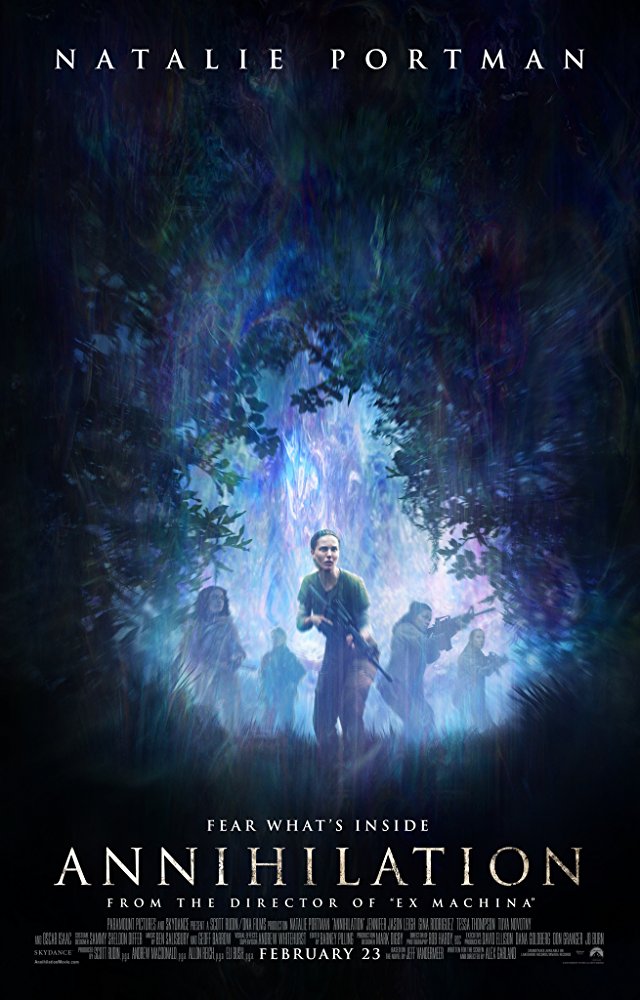
Natalie Portman stars as Lena, a cellular biology professor, still reeling from the disappearance of her husband (Oscar Isaac), who vanished on a top secret mission with the military. After twelve long months, he returns with little to no memory of the mission or how he got back. He falls suddenly ill, but en route to the hospital, the military descend on the ambulance and take both the biologist and her husband to a mysterious facility known as Area X. Demanding answers, Lena learns her husband crossed an inexplicable boundary called The Shimmer and into a zone that many research team enter, but none leave. Lena gets a spot on a new team setting out into the Shimmer in hopes of understanding what is happening.
Alex's Review
There's an immediate feeling that you can’t seem to shake, and it's a sense of unnerving anxiety that surrounds the mystery of The Shimmer. Everything is presented straightforward cinematically, but all the information you are given breaks down the further you get into the film. This instability can be communicated by something as simple as a jump cut. We see, firsthand, how the characters cross into this enigmatic zone and then suddenly “wake up’ only to realize they have lost four days. These sensory gaps become even more intriguing when we consider that the entire story is told from the perspective of the only surviving member of the expedition. How do know we can trust what she says? It's reminiscent of Arrival in that sole testimony, how characters seem to use select words wrong at times, and the actions of a certain individual during the finale. Their actions challenge the notion of the phenomenon that makes one question even further the preceding events.
On a technical level, I’m a bit torn. Little effort is present during downtime sequences, but the scenes that matter have just the right amount of concrete fundamentals as well as flair. Specific scenes that come to mind are a few animal attacks - for instance, there is a scene where a genetically altered bear slowly enters a room where our protagonists are in the midst of an escalating confrontation. Everyone has their back to the door and are afraid any movement will set it off. We can see the bear enter, but it's out of focus because no one has seen it clearly, and it's only when the it sticks its face between the crew that we catch a few focused glimpses of the creature. On the other hand, these creatures in action are one hundred percent CG and it wouldn’t bother me if some of them didn’t look like assets from a Playstation 2 game in 2004. In other scenes, there are great displays of prosthetics that are examined closely and you have a chance to take in the breathtaking work. The dichotomy between these effects took me out of the film momentarily, but only when they were on screen, and it's a testament to the intrigue around The Shimmer.
It's hard not to give Garland a hand for transferring a complex story into an accessible studio film. For the most part, it's seamless, but there are problems in the very last twenty minutes. Garland clearly respects his audience as well as the people who wander their way into the theater, unsure of what they're in for. The rules of the world are explicit and concise without getting too technical or too vague, which is understandable since the crew is made up exclusively of scientists. This level of broad tactfulness is honestly astonishing. Ex Machina was a quiet, exploratory, off-putting experience for many viewers, but seeing that he can handle a more conventional blockbuster-style movie has me excited for Garland’s future with bigger budgets and more creative freedom.
-Alex B.
Brian's Review & Analysis
Annihilation is a little different on the page, so what follows is the summary transcribed directly from the back cover of Jeff VanderMeer’s novel. Note that in discussing both the movie and the novel, my references will swing freely between the two, and that although I will do my best to make it clear when I am talking about one or the other, I will almost inevitably slip.
The summary reads:
Area X has been cut off from the rest of the world for decades. Nature has reclaimed the last vestiges of human civilization. The first expedition returned with reports of a pristine, Edenic landscape; the second expedition ended in mass suicide, the third in a hail of gunfire as its members turned on one another. The members of the eleventh expedition returned as shadows of their former selves, and within weeks, all had died of cancer. In Annihilation, the first volume of Jeff VanderMeer’s Southern Reach Trilogy, we join the twelfth expedition.
The group is made up of four women: an anthropologist; a surveyor; a psychologist, the de facto leader; and our narrator, a biologist. Their mission is to map the terrain, record all observations of their surroundings and of one another, and, above all, avoid being contaminated by Area X itself.
They arrive expecting the unexpected, and Area X delivers--but it’s the surprises the came across the border with them and the secrets the expedition members are keeping from one another that change everything.
At bottom, Annihilation is a deconstruction of the relationships between language, communication, and meaning masked as a straightforward account of an expedition gone wrong--a stray thought the biologist has early on, that we do not generate ideas but are colonized by them, doubles as the novel’s thesis. Garland’s film ignores it, choosing to preserve the aspect of an expedition and step up the ecological horror that makes up the novel’s periphery, altering enough details along the way as to fashion a completely different story. His Annihilation is like Solaris in the way it frames the sci-fi around an emotional journey, deploying instances of freakishness to pry into the psyches of its characters. Had the movie hewn closer to the novel, the result may have been like a nightmare version of Arrival, deriving its horror from the limitations of communication and the changeability of meaning. For example: one of the first things the biologist and her team encounter once inside Area X (in the novel, this is the name of the zone inside “The Shimmer,” rather than the facility from which the team deploys) is a manmade structure. We are explicitly told by the biologist that the structure is a tunnel. Rationally, she understands that it is a tunnel, and all of her senses agree, but she cannot bring herself to believe it is anything but a tower. Although we are explicitly told that this structure is a tunnel, the biologist can only thereafter describe it as if it was a tower, and soon, we forget the tunnel. We are colonized by the idea.
You will find more of this decidedly Weird content the deeper you go in the novel, and virtually none of the movie’s sympathetic portrayal of a woman in search of answers to the mystery that robbed her of her husband. The novel is a linear, first-person account intended as a scientist’s defense of her sanity, and her sometimes desperate need to be rational, factual, and clearly understood in response to phenomena that are not any of those things lends the novel a unique tension that would have been cumbersome to realize on screen. The additions of scenes between Lena and her husband, and the fact that he not dead before the movie even begins; that we are allowed to observe Lena’s fractured psyche in the wake of his disappearance, and how it leads her to infidelity, confusion, and emotional isolation; the ramped-up action, including a “bear attack,” and the greater focus on the scientific anomalies within Area X/The Shimmer: these things belong to the movie and are necessary to a more cinematic adaptation of Annihilation. We can applaud their execution and how they make the story more digestible. It’s a very, very good movie. At the same time, we can recognize how these things are clutter.
Toward the end of VanderMeer’s novel, the biologist discovers a mouldering heap of notebooks that appear to have been left behind by previous expeditions. It’s clear by the sheer volume of material that there were far more than eleven previous expeditions. She begins to comb through them in search of information. She singles out one notebook in particular, although it ostensibly contains no information--instead, it seems to be filled with nothing but repetitive, exhaustively-detailed descriptions of a type of thistle that grows within Area X. She reads it, but puts it down, unnerved, when she begins to understand that its singular focus seems to be less the product of mundane obsession than of terror--as if the author was trying to avoid something more horrifying, something he or she could not bring themselves to discuss. To some degree, this seems like a reflexive commentary on Annihilation itself, if not the very philosophy by which it was written. As a first-person account of an event of which only she was witness, we are subject to the limits of her imagination, the limits of her vocabulary, and the limits of her discretion--we have only her testimony, and there is plenty of reason to doubt that she is telling us everything, even when she swears she is, whether by choice or by pure limitation. What is she hiding? What doesn’t she realize she’s hiding?
This unreliability is translated into the movie’s classic flashback structure. Lena verbally recounts the events of the expedition to interrogators in hazmat suits, as well as an audience of Area X personnel lined up outside the glass walls of the interrogation room. It is also addressed in a scene exclusive to the film, when a member of the expedition ties up the others and accuses them all of a conspiracy, singling Lena out as its mastermind when she discovers that her husband was a part of the previous expedition. Setting aside the fact that her relationship to a previous expedition member is no secret in the novel (also, that the biologist does not harangue her way onto the team; she volunteers, and the other members are fully aware of her emotional investment in the expedition, and in fact train together for many weeks prior to entering Area X), this scene could be interpreted as a manipulative fabrication by Lena, a sort of built-in “proof” of the veracity of her story. Her truthfulness seems to have been tested by this confrontation while inside The Shimmer, but how do we know the confrontation, or any of her story, actually happened? She seems to have vindicated herself of doubt, but what proof do we have but her word?
The most glaring omission from the film is the expedition team’s voluntary hypnosis at the hand of the psychologist (Jennifer Jason Leigh’s character in the movie; also, the director of the Southern Reach, a fact key to Annihilation’s follow-up, Authority). Early in her account, the biologist mentions that she has become resistant to the psychologist’s hypnotic suggestions, which she attributes to exposure to some of Area X’s plantlife. After a while, she is able to identify the commands in the psychologist’s speech by the emphasis the psychologist places on certain phrases, and the further the hypnosis erodes, the more she seems to understand about Area X. Again, there is doubt toward this assumption--she was, after all, contaminated by something which she refers to as a “brightness,” only as an approximation--but the larger importance of hypnosis in the novel, and its exclusion from the movie, is multilevel. In the novel, this language-activated hypnosis is a useful metaphor for the experience of reading; we are comfortable with certain writing and narrative tropes, without our native languages, and when they are subverted or eliminated as they frequently are in Weird fiction, we find ourselves lost in a wilderness of words without definitive meaning. Removing this element was the right choice for the film; it would only complicate the already dense analogies between Lena’s emotional arc and the escalating danger within The Shimmer. This hypnosis is also important to Authority, which means that to some degree, it is tool of foreshadowing that would have been useless to the film. Once again, it was necessary to cut.
However you choose to interpret the role of hypnosis in the novel, it radically shapes the reading. Taken literally, it shields the expedition from the more ungraspable anomalies within Area X, preserves their objective, and protects their sanity. Taken metaphorically, it draws attention to the formal elements of the writing--to the diction, grammar, syntax, and perspective--and opens the novel up to myriad interpretations in concert and in conflict with one another, creating an overlapping swarm of ideas that, not unlike those first flowers Lena observes in the film, are “stuck in a constant mutation.” In place of the hypnosis, I think Garland’s Annihilation does a very smart thing: it gives its role to the Shimmer, which, as Josie (Tessa Thompson) describes in what I still can’t decide is necessarily clunky or just clunky exposition, is a prism; a force that refracts the basic composition of everything it affects into ever-more kaleidoscopic configurations--leading to shark-toothed crocodiles, parroting bears, human-shaped plants--just as the emotional strain of separation, absence, and loneliness changes Lena over time; just like the movie’s flashbacks to the months since her husband’s disappearance radically alter the viewing and our understanding of Lena. Perhaps the movie is the Shimmer, delicately reconstructing VanderMeer’s story from the inside out; perhaps it’s the light-creature that’s taken up residence in the lighthouse (via projectile, as we see in the very first seconds of the movie), whose intention is neither to harm or to help, but simply to make something new.
The third act of Annihilation has attracted discussion, and with good reason--it’s weird as hell. The novel’s climax is, if anything, even more ambiguous and outlandish: the entity the biologist eventually encounters is described through a cascade of confusing imagery that makes it more unknowably alien than a shape-shifting, psychedelic orb of smoke and light could possibly be. With that caveat out of the way, it’s hard to argue that what happens in the lighthouse isn’t one of the most fascinatingly strange sequences in a movie of this budget and caliber we’ve seen yet, off-putting and enticing in equal measure, and in all the right ways. The sudden, sustained eruption of the score, absent for most of the movie, is glorious; in a well-equipped theater, when that ethereal snatch of melody present in the trailer slides in over a gut-rattling bass hum, it will feel as if you are floating out of your seat and into the screen like Lena’s blood drawn into the light.
The climax of the novel is a peek into greater mysteries, maybe more than the Southern Reach Trilogy can answer, lodging the chill of cosmic horror deep in the bones; in the movie, it’s a moment of mingled horror and catharsis as Lena confronts both the truth of what happened to her husband and what will happen to her, capped with the claustrophobia of the entity, assuming humanoid form, nearly crushing Lena against the lighthouse wall. It’s at once a terrifying facsimile of a hug, a rapist pose, and a futile effort at closeness, made more disturbing by the fact that it may not have even been aware she was there, as Lena later reports. And then, of course, the final Invasion of the Body Snatchers twist. There is precedent in the novel--the shine in her eyes when she embraces her husband’s replacement seems to represent the “brightness” the biologist feels inside of her, not quite a consciousness, not quite a light, but somewhere in between--and, in fact, it makes perfect sense according to the movie’s emotional logic. Lena is not who she was; Garland’s movie literalizes that.
Annihilation is a great movie and a bad adaptation. It can be both. It takes much of what’s superficial about Jeff VanderMeer’s novel and crafts a compelling movie out of it with a completely different agenda in mind, which is hardly a bad thing: Annihilation impresses on its own terms, with great performances and consistent internal logic. There are numerous little differences and deviations from the source material than can be bothersome, but ultimately cannot impede or detract from the movie’s ability to captivate. Garland’s Annihilation not a good representation of Jeff VanderMeer’s, but in a way analogous to the relationship between Stephen King’s The Shining and Stanley Kubrick’s film adaptation--and that, I think, is the highest praise I could possibly give it.
- Brian L.
Archival details
- Original URL
- https://metallifestyle.weebly.com/curtains-movie--tv-reviews/joint-review-annihilation
- Recovery source
- live-weebly
- Recovery date
- 2026-07-22
- Stewardship polish
- 2026-07-22
- Preservation status
- restored
- Missing assets
- None recorded
Preserved by Bloodsoaked Media · The Archives